


An alchemical process, an expression of the soul
xo-cu
In Mexico, many of us grow up surrounded by objects whose stories we don’t really know.
In our grandparents’ homes, it is not unusual to find small decorative plates hanging on the walls or beautifully painted little chests displayed in cabinets — covered in colourful flowers, polished to an almost perfect shine and finished with delicate golden lines.
We grow up seeing them, but rarely stop to ask: Why the little plates? Why the tiny chests? And how are they actually made?
For someone discovering them for the first time in Britain, they may simply look like beautiful examples of Mexican craftsmanship. But behind these familiar objects lies a fascinating story of history, patience and knowledge passed from one generation to another.
This is laca perfilada en oro — Mexican gold-outlined lacquer.
A tradition from Pátzcuaro
To understand the craft better, we contacted the Casa de las Artesanías de Michoacán, who introduced us to master artisan Mario Agustín Gaspar Rodríguez, from Pátzcuaro, Michoacán.
Mario learnt the technique from a young age and has spent years perfecting it. Today, his work is internationally recognised, and he has passed his knowledge on to his family and younger generations, who are finding new ways to bring this traditional craft into contemporary design and fashion.
From wood to gold and colour


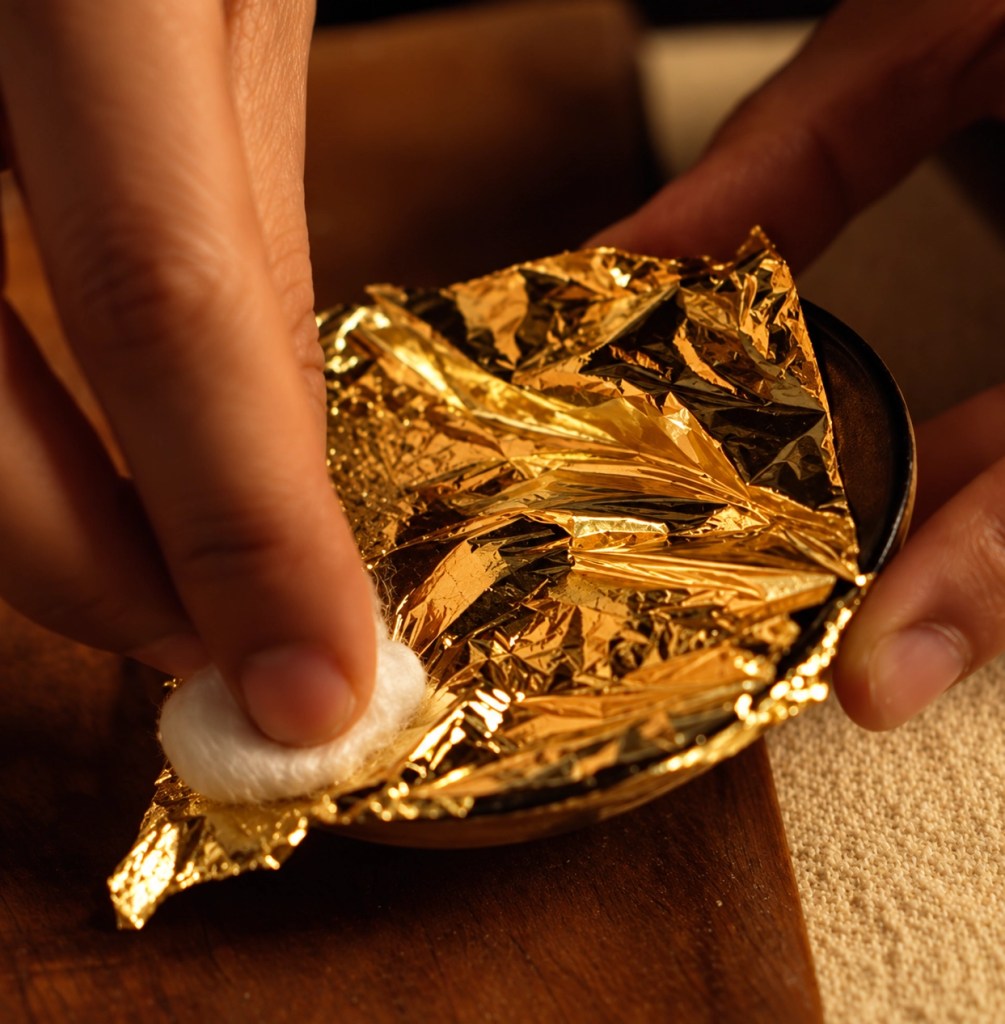


The process begins with a simple wooden object.
Its surface is carefully prepared and polished before layers of coloured lacquer are gradually applied to create its characteristic smooth, lustrous finish. Traditional preparations used to create the lines where the gold will adhere involve natural materials, including clays and minerals. Every stage requires patience.
Once the surface is ready, the artisan draws the design by hand, often inspired by the flowers, birds, animals and landscapes of Michoacán.
Then comes the gold.
The design is traced with a special preparation that allows delicate gold leaf — traditionally around 23 carats — to adhere to the surface. The excess is later removed, leaving only the fine golden outline. Hand-painted details and rich oil colours complete the piece.
What appears effortless takes hours of meticulous work — and years of experience to master.
Why the little plates and chests?


Those decorative plates so familiar in Mexican homes are connected to an ancient object called a batea — a shallow wooden vessel or tray used since pre-Hispanic times.
Bateas originally served practical purposes, from carrying and presenting food and goods to playing a part in gatherings, ceremonies and offerings. Over generations, artisans transformed these functional objects through colour, lacquer and intricate decoration.
The little chests tell a different chapter of the story. During Mexico’s colonial period, larger chests were used to store and transport valuable belongings. Their forms were eventually adopted and reinterpreted by Mexican craftspeople.
Over time, both objects evolved into the smaller decorative pieces we recognise today — jewellery boxes, ornaments and beautiful objects for the home.
So, what may look like a simple decorative plate or tiny chest actually carries the memory of something much older.
From tradition to contemporary fashion

Today, the story of laca perfilada en oro continues to evolve.
Younger generations are taking techniques once associated with bateas, boxes and chests and bringing them into jewellery, handbags, belts and contemporary accessories. And that evolution is important.
Preserving craftsmanship does not mean keeping it frozen in the past. A tradition remains alive when a new generation wants to learn it, practise it and imagine something new with it.
A flower once painted on a batea can become a necklace. A traditional golden motif can become part of a contemporary accessory.
More than preserving beautiful objects

Traditional knowledge does not always live in books. Often, it lives in people.
It is knowing how a material should feel, when a surface is ready for another layer, how long to wait and how much pressure is needed to create the perfect golden line.
These details are learnt through observation, repetition and years spent beside someone who already knows.
That is why passing these techniques on to younger generations matters so much.
For someone in Britain, these pieces may be a first encounter with an extraordinary Mexican tradition. For many Mexicans, however, they evoke something much more familiar: home, grandparents and objects we grew up seeing long before we understood their meaning.
And perhaps that is what makes rediscovering them so special.
Behind every little plate is the memory of the batea. Behind every miniature chest is the story of an object once used to protect something valuable. And behind every flower and golden line is the hand of an artisan carrying generations of knowledge into the future.
Every golden line holds a story.
Perhaps the best way to preserve that story is not simply to admire these objects as part of Mexico’s past, but to discover them, wear them, support the people who make them and allow a new generation to imagine what they might become next.
Leave a Reply